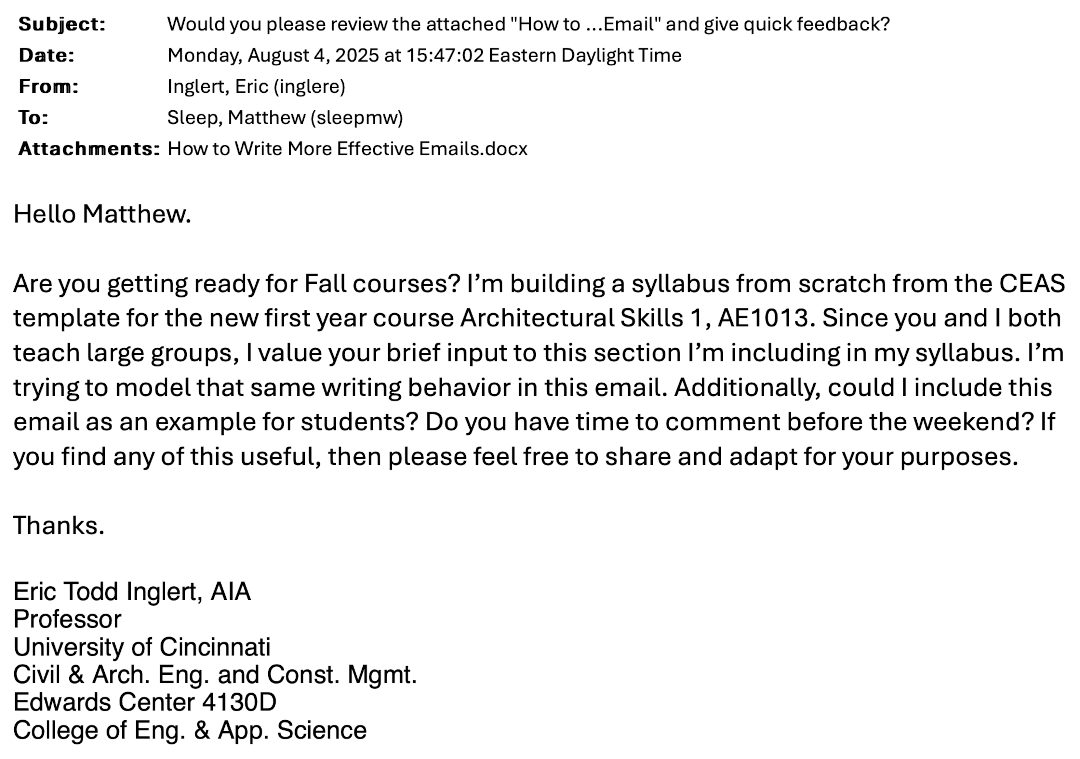
Everyone could do a better job writing effective emails. Your professor included! Since email is the dominant communication mode for business as well as the academy, it is important to write effectively. Effective email writing has been defined as clear, concise, and productive. Stein 2022.
You should identify what actions you want from your email. Limit your Cc: list to only those critical few who need the information. Write the subject line as the main question you seek to answer. After a professional greeting, write in simple active voice sentences. Make sure you indicate when you would want an answer, and do not expect everyone can meet your last-minute deadline! Most of the time it makes sense to seek answers to one or two questions. Having this personal discipline to challenge yourself to a word limit of for instance one hundred words shows that you respect the time of your email recipient. Favor data attachments over inline and embedded text, because many of your readers will only skim the body text.
How about the hundreds of emails you get every day? It is important to have a personal deadline for answering emails sent to you, especially from colleagues and friends. Twenty-four hours is a standard. If you send an email, and your recipient has missed responding in a timely fashion, here is my best personal advice that may seem to some of you to be at the limit of impertinent: Forward the message that you previously sent and replace the “Fw:” in the subject line with the words, “Second request:” Ignoring emails from colleagues and friends is from my observations, since my first email address in 1989, a mistake that leads to professional and personal failure. The corollary of this principle is that long, poorly focused emails are likely to get you ignored!
Proofread once. Do it again. One more time before you hit the send button!
I have modeled below the behavior that I’m discussing here.